If you’ve been playing chess online or with friends and you’re ready to find out where you actually stand, you’re probably wondering how to get a USCF rating. It’s simpler than it looks, but there’s one thing almost every first-timer gets wrong: joining US Chess and getting rated are two separate steps, and you need both.
This guide walks through what a USCF rating really is, what membership costs right now, and – since you’re playing chess in Las Vegas – exactly how to find a real, rated tournament near you and know what to expect once you sit down at the board.
USCF Membership vs. a USCF Rating: What’s the Difference
A US Chess (USCF) membership is something you buy. A USCF rating is something you earn.
Membership is the paperwork step. It makes you eligible to have your games counted by US Chess, the national governing body for over-the-board chess in America. But buying a membership doesn’t give you a number – you don’t get a rating until you actually play in a tournament that reports its results to US Chess.
This trips people up constantly. Someone joins US Chess, then shows up to a casual chess night at a coffee shop or a friend’s house, plays a few games, and wonders why they’re still “unrated.” The answer is that those games were never submitted to US Chess in the first place, so nothing was ever calculated.
As of the most recent US Chess pricing (effective January 2025), the common membership tiers look roughly like this:
| Membership Type | Approximate Annual Cost |
| Adult (no magazine) | $54 |
| Adult Premium (includes Chess Life magazine) | $66 |
| Young Adult, under 23 (no magazine) | $33 |
| Youth, under 18 (no magazine) | $24 |
| Life Membership (one-time payment) | $1,620 |
Prices and tiers do get revised from time to time, so confirm the current numbers directly on US Chess’s official membership page before you pay. Don’t take any third-party number, including this one, as gospel on the day you sign up.
How a USCF Rating Actually Gets Calculated
Once you’re a member and you play in your first rated event, US Chess assigns you a provisional rating. This is your rating explained in the simplest possible terms: it’s an estimate, and it’s designed to move fast.
For your first 25 rated games, your rating is provisional and can swing dramatically after a single event – sometimes 100 points or more in either direction. That’s intentional. The system is trying to figure out where you actually belong as quickly as possible, so it weighs early results heavily.
A few things worth knowing:
- You need to complete at least 4 rated games at a given time control (regular, quick, or blitz) before US Chess will publish a rating for that category at all.
- Once you’ve played more than 25 rated games, your rating becomes established. From that point on, each individual game moves your number much more slowly and predictably.
- Regular, quick, and blitz ratings are tracked separately, based on how much time each player gets per game.
Don’t get hung up on the exact math behind the formula. What matters for a first-timer is this: your first few tournaments are a settling-in period, not a verdict on your ability.
Finding USCF-Rated Tournaments in Las Vegas
The most reliable way to find a rated event near you is US Chess’s own tournament and affiliate locator, which lists upcoming sanctioned tournaments by state and city, including Las Vegas.
A few real, independently confirmed local options currently running USCF-rated events in the Las Vegas area:
- StarWizard Chess Castle (580 E Windmill Ln, Las Vegas) runs USCF-sanctioned tournaments under head coach GM Richard Bitoon, including recurring rated events such as its 1300-and-below training tournaments.
- Elevate Chess organizes USCF-rated tournaments in the Las Vegas area, including regular and quick-rated events open to local players.
- The Southern Nevada Chess Club (SNVCC), a longstanding official US Chess affiliate, has historically run monthly rated and unrated tournaments in Las Vegas. As of late 2025 the club was searching for a new permanent venue after losing its previous location, so check its current site before planning around it.
- Las Vegas also hosts larger annual events like the National Open, part of the Las Vegas International Chess Festival, which draws players from around the country for a USCF-rated tournament with multiple sections.
Because organizers, venues, and schedules change, always confirm directly with the organizer, or check USCF rated tournaments in Las Vegas, before showing up. If a tournament name you’ve seen somewhere doesn’t show up on US Chess’s locator or the organizer’s own listings, treat it as unconfirmed rather than assuming it’s rated.
What to Expect at Your First Rated Tournament
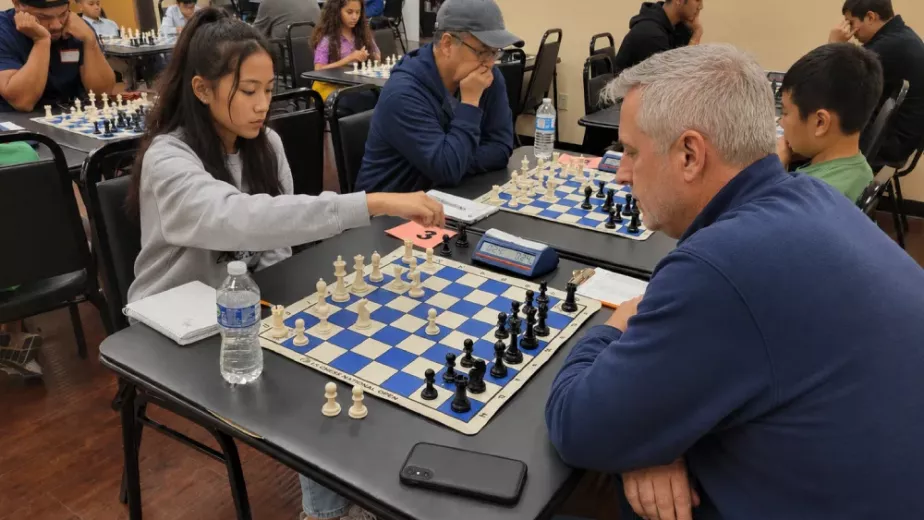
Local one-day rated tournaments in Las Vegas typically run 4 to 5 rounds in a Swiss-system format, meaning you’re paired against opponents with similar scores as the day goes on rather than a single-elimination bracket. Time controls for these local events are often in the 25-to-30-minute-per-player range with a small delay or increment, though some sections run slower classical time controls.
Before you go, bring:
- Your USCF membership confirmation or ID number (you can look this up on US Chess’s player search if you don’t have it memorized)
- A chess clock, if the organizer doesn’t supply one for every board
- A method for recording moves (notation), if the section requires it – many beginner and quick-rated sections don’t
- Cash or a card for the entry fee, and a little extra time to check in before round one
Pairings and byes: if there’s an odd number of players or you can’t play every round, tournaments generally allow a half-point bye, but you usually have to request it before a specific round (often round 1 or 2). Ask the tournament director when you register.
When your rating posts: after the event, the organizer submits results to US Chess. Ratings are compiled into monthly supplements, and the cutoff for each month’s list is usually the third Wednesday of the prior month. In practice, that means your first published rating might not show up for a few weeks, sometimes closer to a month if your tournament falls right after a cutoff.
Rated vs. Unrated Chess: Why It Matters
Not everyone wants a rating, and that’s fine. Unrated, casual chess is lower pressure – you can experiment with openings, take your time, and not worry about a number changing after a bad night.
A USCF rating matters when you want:
- Eligibility for tournaments and sections that require or use a rating (many events sort players by rating band)
- A concrete way to track improvement over months and years, rather than relying on gut feeling
- Scholastic eligibility – many school and youth events require a current US Chess membership and use rating to place students in appropriate sections
- Bragging rights that actually mean something to other competitive players
Rated vs. unrated chess isn’t really about which is “better.” It’s about whether you want your results to count toward something official.
Common First-Timer Mistakes to Avoid
- Showing up without a membership. You generally need an active USCF membership before or at registration – don’t assume you can sort it out afterward.
- Misjudging the time control. A 25-minute game moves fast compared to online blitz habits; players who normally play 10-minute games online sometimes struggle with the slower decision pace, or the opposite – players used to long games get rattled by a shorter clock.
- Skipping the section rules. Some sections cap entry by rating (like “Under 1500”); playing in the wrong section can get you moved or disqualified from prizes.
- Not requesting a bye in time. If you might need to leave early, ask about the bye deadline the moment you register, not mid-tournament.
- Overreacting to a rough first event. Remember that your first rating is provisional and expected to move a lot. One bad tournament doesn’t define your rating going forward.
Find More Las Vegas Rated Tournaments
Once you’ve played your first rated event, the real fun starts: finding the next one. If you want an easier way to keep track of what’s coming up locally, you can join a rated chess tournament and get notified as new Las Vegas events are listed.
Frequently Asked Questions
Do I need to be a certain skill level to enter my first rated tournament?
No. Most local Las Vegas events have beginner or lower-rated sections specifically for new and unrated players. You don’t need any minimum skill level to start.
Is a Chess.com or Lichess rating the same as a USCF rating?
No. Online platform ratings use their own separate rating systems and don’t transfer to or from your official USCF rating, even though both are loosely based on similar rating math.
Can I play in a rated tournament the same day I buy my USCF membership?
Usually yes, as long as you complete your membership purchase before or during on-site registration. Many organizers can help you sign up if you haven’t already.
How much does a first rated tournament in Las Vegas typically cost to enter?
Entry fees for local one-day rated events vary by organizer and section, so check the specific tournament listing for current pricing rather than assuming a flat rate.
What if I lose every game in my first tournament?
Your provisional rating may drop, but it’s designed to correct itself quickly as you play more games. A single rough event isn’t a lasting judgment on your skill.
Do I need a coach before I can play in a rated event?
No. Coaching can help you improve, but it’s not required to enter a USCF-rated tournament.
How do I find my USCF ID number if I don’t remember it?
You can look yourself up using US Chess’s player and ratings search tool with your name, or check the confirmation email from when you joined.
Final Thoughts
Getting a USCF rating isn’t complicated once you separate the two steps: join US Chess, then go play in an actual rated event. In Las Vegas, that means checking US Chess’s own tournament locator alongside real local organizers like StarWizard Chess Castle and Elevate Chess, confirming details directly with them, and showing up ready with your membership squared away.
Your first rated tournament won’t be perfect, and it isn’t supposed to be. It’s the first data point in a number that will settle in over your next couple dozen games. The only real requirement is showing up and playing.