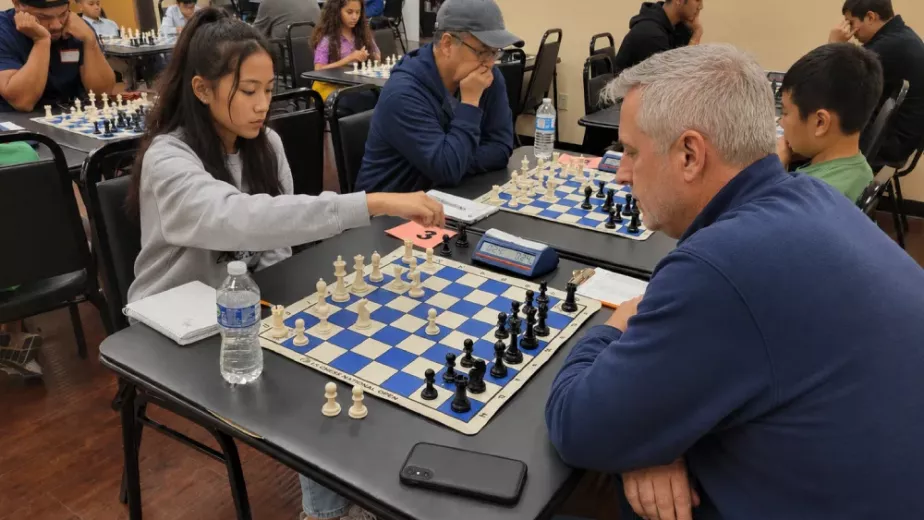
If you’ve played a few tournaments in Las Vegas, you’ve probably run into this question at some point: why do I have a USCF rating but no FIDE rating, or why are these two numbers not even close? The uscf vs fide rating question comes up constantly, and the short version is that they’re two separate systems run by two separate organizations, tracking two separate pools of players.
This guide breaks down what each rating actually is, why your numbers won’t match, which Las Vegas tournaments count for which system, and how to figure out which one you should actually be chasing.
USCF Rating vs FIDE Rating: The Quick Answer
US Chess (USCF) is the national governing body for chess in the United States. FIDE (Fédération Internationale des Échecs) is the international governing body that oversees chess worldwide, including world championships and titles like Grandmaster and International Master.
A player can have a USCF rating only, a FIDE rating only, both, or neither. They’re not the same number, and there’s no official conversion formula between them – treat any chart claiming to translate one into the other as a rough estimate at best, not a real equivalency.
What Is a USCF Rating?
US Chess governs the USCF rating, and it’s the rating you’ll run into first if you’re playing tournaments locally in Las Vegas. It’s earned by playing in tournaments that report results to US Chess, and it requires an active US Chess membership.
Your first 25 rated games put you in provisional territory, where your rating can move a lot from event to event. Once you’ve played more than 25 games, your rating becomes established and moves more slowly. Regular, quick, and blitz USCF ratings are tracked separately depending on the time control you’re playing.
For most Las Vegas players – beginners, scholastic players, weekend tournament regulars – the USCF rating is the one that actually governs which section you play in locally and what your results mean day to day.
What Is a FIDE Rating?
FIDE governs the FIDE rating, and it’s the number that matters if you’re playing internationally, chasing a chess title, or competing in events that draw players from outside the U.S. It’s a separate system from USCF, with its own ID number (a FIDE ID) and its own rating pool.
To get your first FIDE rating, you generally need to:
- Have a FIDE ID, which US Chess can assign to USA-flagged players, typically at no direct cost to you
- Play in a FIDE-rated tournament – not every tournament qualifies, only ones specifically registered and run under FIDE’s rules
- Complete at least 5 games against opponents who already hold a FIDE rating
- Score at least half a point (one draw or better) in those games
- Reach a calculated performance of at least 1400, which is the current minimum published FIDE rating
If your results don’t clear that 1400 performance threshold, you stay unrated under FIDE rules until a future event pushes you over it – your games aren’t wasted, they’re just held until you qualify. FIDE publishes updated rating lists on the first of each month, similar in spirit to how US Chess issues monthly supplements, though the two calendars run independently.
Because FIDE-rated tournaments require a licensed FIDE arbiter and specific registration steps with FIDE well in advance, they’re less common at the local, weekly-tournament level than plain USCF-rated events – that’s true in Las Vegas as much as most of the country.
Why the Two Numbers Don’t Match
Your USCF and FIDE ratings measure your results against two entirely different opponent pools, using separate formulas and separate historical baselines. A player’s FIDE rating is often somewhat lower than their USCF number, partly because FIDE’s rating floor sits higher (1400, versus USCF’s much lower floors) and partly because the two systems simply aren’t built to produce matching outputs.
There’s no official USCF-to-FIDE conversion chart. If you see one online, treat it as a rough personal estimate, not a rule either federation actually endorses.
Which Las Vegas Tournaments Are USCF or FIDE Rated?
Most weekly and monthly local tournaments in the Las Vegas area – the kind run by clubs and local organizers – are USCF-rated only. Running a FIDE-rated event requires a licensed FIDE arbiter and advance registration with FIDE, so it’s a bigger lift for a small local organizer to take on regularly.
The clearest example of a dual-rated event in Las Vegas is the National Open, held annually at the Westgate Las Vegas Resort & Casino as part of the Las Vegas International Chess Festival. Its Open, Under 2300, and Under 2100 sections are FIDE rated, while every section of the tournament is also US Chess rated. Lower “Under” sections below that, along with the Beginners sections, are US Chess rated but not FIDE rated.
For anything smaller or more local – weekend Swiss events, club tournaments, training tournaments – don’t assume FIDE rating status either way. Check the specific tournament’s own listing, or USCF and FIDE rated events in Las Vegas, and confirm directly with the organizer if it isn’t clearly stated.
Which Rating Should You Pursue First?
If you’re a beginner or a scholastic player: start with USCF. It’s the more accessible entry point, it’s what most local tournaments run on, and it’s what determines your section placement in the Las Vegas tournament scene day to day.
If you’re a competitive adult player rated in the 1600–2000+ range: a FIDE rating starts to matter more if you’re interested in playing in bigger regional or national events, want your results recognized internationally, or are simply curious where you’d land in a global rating pool.
If you’re chasing a FIDE title (like FIDE Master, International Master, or Grandmaster) or aiming for a norm: you need a FIDE rating and need to specifically seek out FIDE-rated events, since norms and titles are FIDE’s domain, not US Chess’s.
If you just want to compete locally and track your progress: USCF alone is genuinely enough for most Las Vegas players. Plenty of strong local competitors never bother with a FIDE rating because their goals don’t require it.
| USCF Rating | FIDE Rating | |
| Governing body | US Chess (national) | FIDE (international) |
| Typical entry point | First rated tournament, any local event | Specific FIDE-rated tournament, 5+ games vs. rated opponents |
| Membership/ID required | Active US Chess membership | FIDE ID (assigned via US Chess for USA players) |
| Update frequency | Monthly US Chess supplement | Monthly FIDE list, published on the 1st |
| Best for | Local play, scholastic events, most Las Vegas tournaments | International play, titles, norms |
Confirm current thresholds, fees, and requirements directly on the official US Chess and FIDE sites before making decisions based on this table – both federations do update their rules from time to time.
How to Confirm a Tournament’s Rating Status Before You Register
- Check the organizer’s official tournament listing or flyer. It should state clearly whether the event is US Chess rated, FIDE rated, both, or unrated.
- Cross-check with the US Chess and FIDE websites directly. US Chess’s tournament locator and FIDE’s own calendar list officially registered events.
- Ask the tournament director if it isn’t clear. This is a completely normal question, and organizers expect it, especially from players trying to figure out if an event will count toward a specific rating goal.
Don’t assume a tournament is FIDE rated just because it’s large, prestigious, or has strong players entered – confirm it directly.
Find More Rated Tournaments in Las Vegas
Whether you’re chasing your first USCF rating or working toward a FIDE number, the local Las Vegas tournament calendar has options for both. You can browse upcoming rated tournaments to get notified as new events are listed.
Frequently Asked Questions
Can I have a FIDE rating without a USCF rating?
It’s uncommon for a U.S.-based player, since most FIDE-rated tournaments in the U.S. are also US Chess rated and typically require US Chess membership. But the two ratings are tracked separately once you have them.
Do I need a FIDE ID to play in any rated tournament?
No. A FIDE ID is only required for FIDE-rated events. Plain USCF-rated tournaments only require a US Chess membership.
Is a 1500 USCF rating the same strength as a 1500 FIDE rating?
Not necessarily. The two systems use different opponent pools and formulas, so the same number in each system doesn’t represent identical playing strength. There’s no official conversion between them.
Why does the National Open have some sections rated by FIDE and others not?
Running a FIDE-rated section requires a licensed FIDE arbiter and advance FIDE registration, so organizers typically apply it to their upper sections, where players are more likely to want an international rating, while lower and beginner sections stay US Chess rated only.
How long does it take to get a FIDE rating after my first qualifying tournament?
FIDE publishes updated rating lists on the first of each month, so your first rating typically appears on the list following the month your qualifying results were submitted.
Does a FIDE rating expire if I stop playing?
FIDE ratings don’t disappear, but if your rating were to fall to the FIDE floor of 1400 or below through play, you’d be treated as unrated again under current FIDE rules. Confirm current inactivity and floor rules directly on FIDE’s site, since these can change.
Is it worth getting a FIDE rating if I only play locally in Las Vegas?
For most casual and club-level players, no – a USCF rating covers everything you need for local play. A FIDE rating becomes worth pursuing once you’re aiming at events, titles, or recognition beyond the local scene.
Final Thoughts
The uscf vs fide rating question really comes down to scope: USCF is your national, local-tournament rating, and FIDE is your international one. Most Las Vegas players only ever need the first. If your goals eventually point toward titles, norms, or international competition, that’s when it makes sense to start specifically seeking out FIDE-rated events and tracking both numbers side by side.